
- A Juel litigation funding loan can cover legal fees, paid directly to your lawyer, and living expenses, paid as a lump sum or in stages. (Source: Juel FAQs)
- Juel loans are full recourse. You are responsible for repaying the loan regardless of the outcome of your case. (Source: Juel FAQs)
- Costs are a 2% establishment fee (minimum $1,650 incl. GST), a $275 monthly administration fee (incl. GST) and interest from 15.95% p.a., charged on the funds you actually draw. (Source: Juel FAQs)
- The minimum loan is typically $20,000, and you need a lawyer acting for you to apply. (Source: Juel FAQs)
- In NSW workers compensation, weekly payments are up to 95% of pre-injury average weekly earnings for the first 13 weeks, then drop to 80% if you have not returned to work for at least 15 hours a week. (Source: icare NSW)
- In NSW, a CTP claim for common law damages must be made within 3 years of the crash, and generally cannot be settled within 2 years unless permanent impairment is more than 10%. (Sources: SIRA NSW, Chamberlains)
- In NSW, a family provision claim against an estate must generally be filed within 12 months of the date of death. (Source: Chamberlains)
- Loading table of contents…
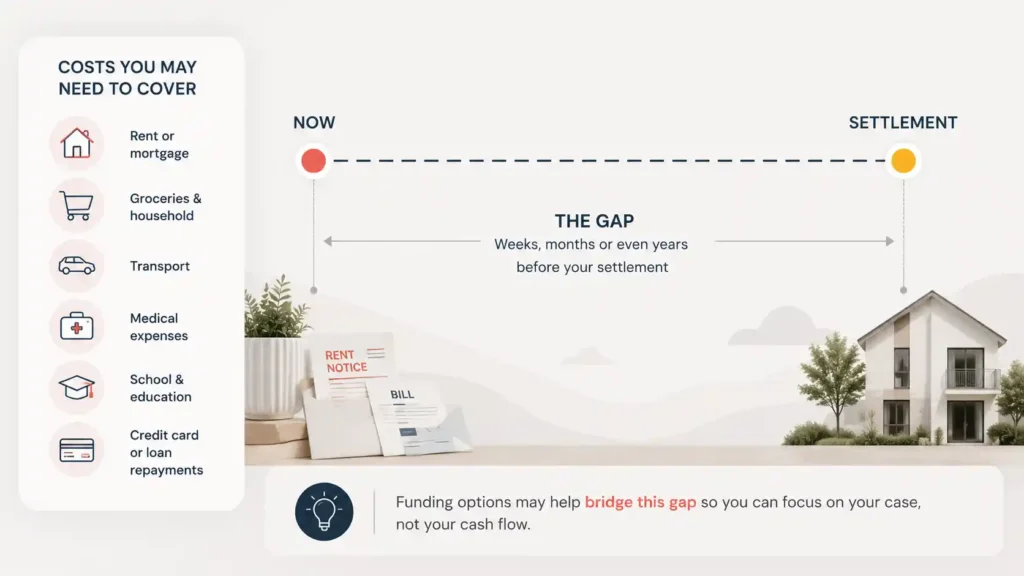
When a personal injury claim or an estate dispute is still running, the bills do not wait for it to finish. Rent is still due. If you cannot work, your income may have stopped or dropped, while legal fees keep arriving. Most people in that position eventually ask the same practical question: can I get money before my settlement?
You can. But the term “advance on settlement” covers more than one kind of arrangement, and they work very differently when a case does not go your way. This article explains how getting money before a settlement works in Australia, what your real options are, what a Juel loan costs, and what you should understand about repayment before you draw a dollar.
What Is an Advance on Settlement in Australia?

In Australia, these arrangements fall into two broad groups:
- Litigation funding loans. A lender covers your legal fees and, in some cases, your living costs. You repay the amount drawn plus fees and interest, usually from the proceeds of your matter. Juel provides this kind of loan.
- Outcome-based funding. A funder pays the costs of the case in exchange for a share of any money recovered. If the case fails, the funder usually receives nothing. This model is most common in large commercial disputes and class actions.
Both are used in personal injury claims, including workers compensation, motor vehicle and public liability claims, and in estate disputes, including contested wills and family provision claims. Which one you are offered changes what you owe and when, so confirm it before you sign anything.
Why People Need Money Before Compensation Arrives
The cost of a legal matter starts long before it ends. Legal fees begin at the first appointment. In a personal injury matter you may be off work. In an estate dispute, distributions are often held until the dispute is resolved, so beneficiaries can wait a long time for money they expect to receive.
Statutory schemes help, but they rarely replace everything. In NSW workers compensation, for example, weekly payments are up to 95% of your pre-injury average weekly earnings for the first 13 weeks, then drop to 80% if you have not returned to work for at least 15 hours a week (icare NSW).
The most common financial pressures facing claimants before settlement include:
- Legal fees and disbursements, such as expert reports, building up before any money arrives
- Lost or reduced income while you recover or manage the matter
- Medical and rehabilitation costs not covered by interim payments
- Rent or mortgage repayments that continue regardless
- Family costs, including school fees, childcare and support for dependants
How an Advance on Settlement Actually Works
With Juel, getting money before your settlement follows a set process. Because the loan is a credit product, Juel looks at both your legal matter and your circumstances. You can read more on how Juel works.
The general process works as follows:
- Enquiry. You, or your lawyer on your behalf, make a confidential enquiry. Making an enquiry does not involve a credit check.
- Conversation. Juel speaks with you about your situation and, with your consent, with your lawyer about the matter.
- Suitability review. The matter is reviewed against Juel’s lending criteria, including the strength of the claim, the expected outcome and the security available.
- Formal application. If the matter is suitable, you apply formally. This includes a credit assessment, and the credit enquiry may appear on your credit file.
- Decision and funding. Decisions can often be made within a few days once all the details are in. Funds are usually available within 2 to 5 days of approval.
- During the matter. Legal fees are paid progressively, directly to your lawyer. Living expenses can be paid as a lump sum or in staged drawdowns.
- Repayment. When the matter resolves, the loan is generally repaid from the settlement or judgment. Because the loan is full recourse, repayment is still owed if the matter is unsuccessful.
Your Options Compared: Getting Money Before Settlement
There is more than one way to cover costs before a settlement. Each option has a different cost, a different repayment trigger and a different risk if the matter does not succeed.
| Option | How It Works | Repayment | Risk to Claimant | Best Suited To |
|---|---|---|---|---|
| Credit card | Revolving credit for expenses | Monthly minimum, with interest | Still owed | Small, short-term gaps |
| Statutory benefits (workers compensation or CTP) | The insurer pays weekly income support and treatment costs under the scheme | Not repaid | Depends on the scheme rules and the status of the claim | Anyone eligible. Check these first |
| Interim distribution (estate matters) | The executor releases part of an expected share before the estate is finalised | Deducted from your final share | Not applicable | Estates where the executor agrees a release is safe |
| Litigation funding loan (such as Juel) | A lender covers legal fees and living costs during the matter | Generally from the settlement or judgment | You still owe the loan, fees and interest | Matters with a lawyer engaged, a clear claim and a need of $20,000 or more |
| Family support | Informal help from family or friends | As agreed | As agreed, with relationship risk | Short-term bridging |
| Outcome-based funding | A lender advances a fixed amount | The funder takes its share at resolution | Usually nothing is owed | Mostly large commercial claims and class actions |
| Accepting an early offer | You settle sooner to get paid sooner | Not applicable | The matter closes, possibly for less than it is worth | Only with independent legal advice |
| Personal loan | Accepting the insurer’s or estate’s offer to access funds sooner | Monthly repayments start straight away | Still owed | Short-term needs with steady income |
Interest rates and fees vary across these options, so compare the total cost over the likely length of your matter, not only the monthly figure. The main differences are when repayment starts and what happens if the matter does not succeed.
Why the Structure of Your Advance on Settlement Matters
The most important term in any advance on settlement is recourse: what you owe if the matter does not succeed.
- Full recourse. You repay the amount drawn plus fees and interest whatever the result. If the settlement is smaller than the loan balance, or the matter is lost, the balance is still owed. Juel’s loans are full recourse (Juel FAQs).
- Non-recourse. Repayment depends on the outcome. If the matter fails, you usually owe nothing. If it succeeds, the funder usually takes a share of the recovery, and that share can be large.
Other terms to check before you sign:
- What is covered. Some funders pay legal fees only. Juel can cover legal fees and living expenses.
- How costs are calculated. Costs can be a percentage of the outcome, a multiple of the amount advanced, or interest and fees on the funds you draw. Ask for the total cost in dollars over a realistic timeline.
- Security. Most Juel loans are secured against the legal matter. Some loans need additional security, such as a mortgage over property.
- Control of the case. A funding arrangement should not give the lender or funder a say in legal strategy or settlement decisions.
- Early repayment. Check whether you can repay early and how that affects the cost.
What an Advance on Settlement Costs With Juel
| Cost | Amount | How it applies |
| Establishment fee | 2% of the loan amount, minimum $1,650 (incl. GST) | Charged once. Can be funded from the loan. |
| Monthly administration fee | $275 (incl. GST) | Charged monthly |
| Interest | From 15.95% p.a. | The actual rate depends on the individual matter |
Fees and interest apply only to the funds you actually draw, not the full approved amount. Fees and charges can be funded from the loan proceeds, so you do not need to pay them upfront. All fees and terms are set out before you agree to anything, and early repayment may be possible depending on your loan terms (Juel FAQs).
How Juel Supports Injury and Estate Claimants

Juel is an Australian licensed credit provider. We provide loans that cover legal fees and living costs for people with Family Law matters, personal injury claims and estate disputes, so the length of a matter does not decide its outcome.
We fund two kinds of cost. Legal fees are paid directly to your lawyer as they are invoiced, so your legal team can keep working. Living expenses, such as rent, healthcare and household costs, are paid to you as a lump sum or in stages.
- Every application is reviewed by people, not an automated system
- We look at the strength of your matter as well as your circumstances
- Repayment is generally made from the proceeds of your matter, such as a settlement or judgment
- You keep your lawyer, and your lawyer keeps control of the legal strategy
- All fees and terms are disclosed before you proceed
A Juel loan is not the right fit for every situation. Because the loan is full recourse, it suits matters with a clear claim and a realistic expected outcome, where financial pressure is putting a fair result at risk. If you are not sure whether your matter fits, a confidential conversation will tell you, with no obligation.
Find Out If Juel Can Fund Your Matter.
Speak with our team about your injury or estate matter. Confidential, no obligation, assessed on the merits of your specific circumstances.
Frequently Asked Questions About Getting Money Before Settlement
The Answer Is Yes. Know the Terms Before You Draw.
You can access money before a settlement in Australia. For people facing a long injury claim or estate dispute, it can be the difference between holding out for a fair result and taking the first offer. But an advance on settlement is a financial commitment as well as a source of relief.
Before you draw anything, be clear on three points: whether the arrangement is full recourse or non-recourse, the total cost over a realistic timeline, and how repayment works when the matter resolves. Juel’s loans are full recourse, with fees and interest set out before you proceed, so you know what you owe whatever the outcome.
If financial pressure is making the decision harder, a conversation with Juel is worth having before you commit to anything. It is confidential and there is no obligation. Speak with our team.
Advance on Settlement in Australia: At a Glance
| Matter Type | What you are waiting for | Timing rule to know | What a Juel loan can cover |
|---|---|---|---|
| Workers compensation (NSW) | Weekly payments, then any lump sum or damages | Weekly payments drop from up to 95% to 80% of pre-injury earnings after 13 weeks for many workers | Legal fees and the income gap |
| Motor vehicle accident (NSW CTP) | Common law damages | Claim within 3 years. Generally cannot settle within 2 years unless impairment is more than 10% | Legal fees and living costs while you wait |
| Public liability and other injury claims | Settlement or judgment | Varies by claim and by state | Legal fees and living costs |
| Estate dispute (contested will or family provision) | Distribution of the estate | In NSW, family provision claims must generally be filed within 12 months of the date of death | Legal fees and living costs while distributions are held |
| All eligible matters | A fair outcome | Early offers can undervalue a claim | Room to negotiate on the merits |
Juel Finance provides litigation funding loans for personal injury and estate matters across Australia. This article is general information only and does not constitute legal or financial advice. Please seek independent legal and financial advice appropriate to your specific circumstances.
Last updated: October 2026


